
Developers don’t need open office spaces that foster spontaneous collaboration. They need a quiet place for deep concentration.
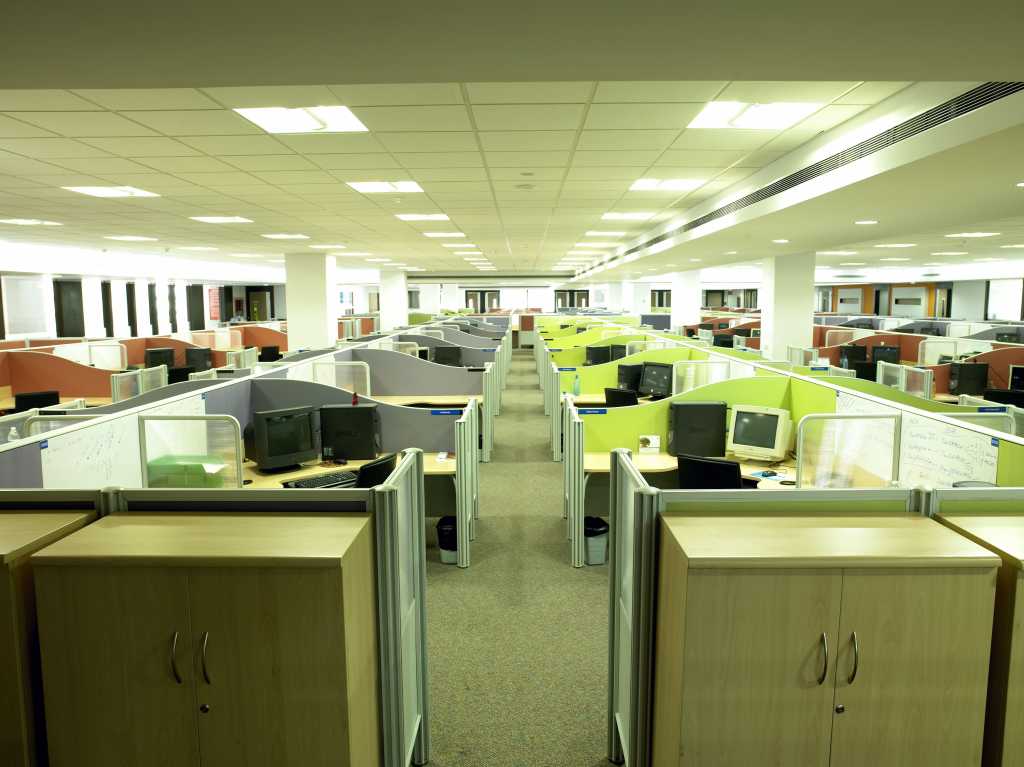
I have yet to meet a software developer who said, “I just love working in a cube farm.” I’ve never run across a developer who would turn down an offer to work in their own office. And I’ve never met a software developer who said, “You know, distractions and interruptions are great for my productivity!”
But I have met plenty of software development managers who think that developers need nothing more than a workstation, a network connection, and a few inches of elbow room. Now, I have never actually heard a development manager say, “I’d love to create a working environment designed to stymie concentration!” or “Let’s set things up so it’s super easy to interrupt the developers with a question.” But they seemed to have those goals.
In a past career, I had an opportunity to help design a new building for a software company. I explicitly and willfully didn’t want to be one of the aforementioned managers who subconsciously (consciously?) created a working environment designed to limit developer productivity. When the architects called me in to get my input on how the building was to be designed, I had only two things on my list: indirect lighting and offices for the developers.
Here is my mini-rant about lighting. Most offices have those hideous fluorescent lights with the checkerboard coverings that shine their harsh light right down on your eyes and that drive you nuts with the buzzing and occasional flickering.
Lighting in an office should point upwards, softly bouncing light off the ceiling. This seems blatantly obvious to me. And people wonder why I wear a baseball hat in the office.
A door for every developer
The other item on my list? Offices with a door for every developer. Small offices would be fine. Even offices with frosted glass fronts would be great. Developers need a quiet personal space, where they can concentrate, as Borland understood. But alas, it was not to be. The offices were deemed too expensive. Even high cubicles with doors cost too much. Alas.
Old school companies seemed to understand a bit more what developers need. Joel Spolsky understood it as far back as 2003. He was well aware that the “standard” space just wouldn’t cut it for developers.
At its peak, Borland built a beautiful campus with a magnificent office building made up of six three-story pods. The third floor of each pod was dominated by offices pretty much everywhere. These spaces let the software team shut the door and actually think. Borland’s culture was such that only a reverent soul would venture onto the third floor to talk to a developer.
The unwritten rule was that if a developer’s door was closed, they were to be left alone. If the door was open a crack, you could knock, but you’d better have a good reason. An open door was an invitation to come in and talk.
Now that’s a culture that understands developer productivity.
As we are all too well aware, cubicle farms are the norm, despite their obvious disadvantages. And if cube farms weren’t bad enough, some managers started advocating for “open offices” where no one has an office, not even a cubicle, because the alleged collaboration benefits outweigh the disadvantages that common sense tells us these silly office layouts bring. Sometimes all I can do is shake my head.
Concentration-cancelling workspaces
“Solutions” for these manager-made problems often include, “Well, just wear noise-cancelling headphones.” That’s great, but that is a symptom, not a cure. If developers have to pipe white noise into their ears to be able to concentrate, maybe the problem isn’t your developers not being able to adapt, but your cheap, “modern” office layout.
Open offices are supposed to lead to all kinds of spontaneous collaboration and serendipitous meetings that lead to marvelous ideas. Great in theory, but not so great in practice. Developers don’t lack collaboration. They lack uninterrupted time to do their work.
We pay software developers big salaries and buy them expensive computers, and then we skimp on their workspaces. We hire them to produce work that requires deep concentration, so why not let them do that? No one ever thinks “Hey! Let’s have open spaces for the orchestra members to individually practice!” No, they get their own practice rooms.
You don’t put a thoroughbred in a stall for pack mules. So the next time you’re planning a workspace, ask yourself: Do I want software that runs fast and stable—or just a lot of developers wearing headphones pretending they are concentrating?